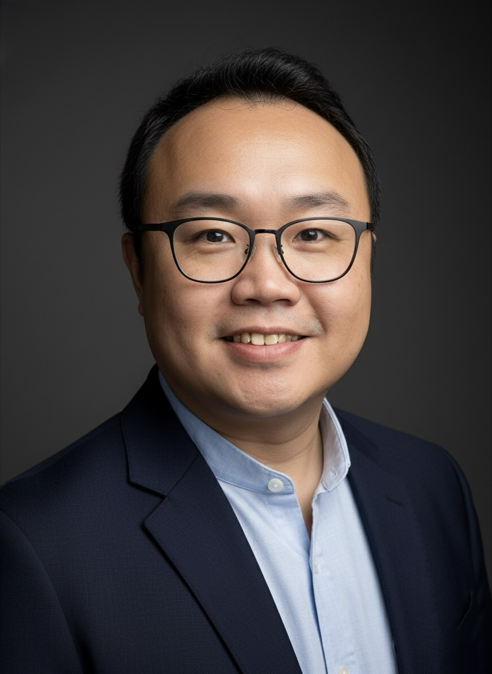
Kenny Choo
HCI researcher working on Human-Centred AI for sensitive, high-stakes settings
I am an Assistant Professor in the Design and Artificial Intelligence programme and Information Systems Technology and Design pillar at SUTD, where I lead the Context-Aware Interaction Lab.
My research is Human-Centred AI: designing and studying AI systems that people can understand, question, and act with, in sensitive, high-stakes settings where the cost of getting it wrong is borne by people, not systems. I build these systems with computer vision, audio, and natural language processing, and I evaluate them with the same rigour I bring to designing them: claims about what an AI system does for people have to be measured, not asserted.
Research areas
All research at CAILab-
AI in Care and Sensitive Settings
AI agents that help people put difficult decisions into words in advance care planning, multimodal models aligned with speech-language pathologists on parent–child interaction (both CHI 2026 Honourable Mention Awards), and AI for mental health that supports peer supporters and caregivers. Throughout, I ask who carries the responsibility and emotional labour when AI joins a care relationship.
-
Multimodal Human–AI Interaction
AI that works across sketch, speech, video, and 3D: TalkSketch, which lets designers sketch and talk to generative AI at the same time; interfaces for modelling physical objects in virtual reality; and drone-based computer vision that gives swimming coaches real-time analytics.
-
Responsible AI: Risks and Robustness of Language Models
Where language models fail and whom those failures harm: how people use LLMs as both sword and shield in disinformation, how offensive-language detectors break under the cloaking and code-mixing of online speech, including in the low-resource languages of Singapore, and how well models understand cultures beyond the English-speaking world.